


With COP 30 just a few days away, the University of French Guiana is fully committed to the climate. By organising a series of meetings on the challenges of climate change in the Amazon, researchers, students and international partners are coming together to devise tomorrow's solutions. The aim is to make university research a driving force for action on the planet.
Amazonia at the heart of COP 30
Held from 10 to 21 November 2025 in Belém, COP 30 is a United Nations international conference devoted to the fight against climate change. This edition is crucial for the Amazon, a territory that is both highly vulnerable and a beacon of hope. Its unique biodiversity, vast forest cover and wealth of traditional knowledge make it an open-air laboratory for developing bio-inspired solutions.
The University of French Guiana: the driving force behind scientific cooperation in the Amazon region
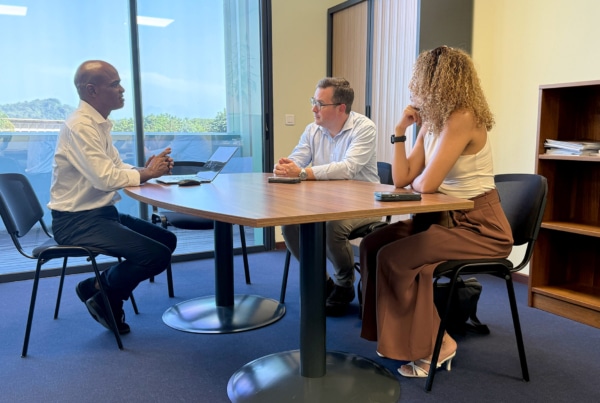
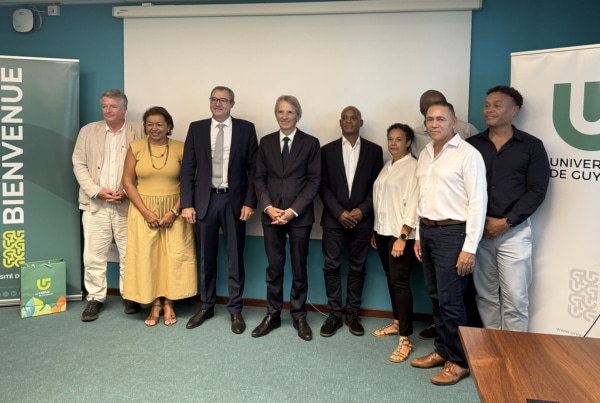
In the run-up to COP 30, the University of French Guiana, in partnership with the Franco-Brazilian Centre for Amazon Biodiversity (CFBBA), organised a series of conferences with several partner universities in Brazil: UNIFAP, UFPA, UFOPA, UNICAMP and FIOCRUZ. These exchanges provided an opportunity to share academic and indigenous knowledge, while raising civil society's awareness of the tangible impacts of climate change.
Three key themes for the Amazon of tomorrow
Health and climate: understanding new vulnerabilities
Researchers have highlighted the effects of climate change on health:
- increased spread of vector-borne diseases such as Chagas disease,
- mercury pollution and associated pathologies,
- respiratory risks linked to airborne fungi.
Avenues for action are emerging: predictive surveillance tools, epidemiological biomonitoring, and the integration of traditional medicines into care pathways.
Sustainable energy and social transition
At the second conference, discussions focused on the energy transition and equitable access to energy.
Inspiring projects were presented:
- a Brazilian model combining solar energy and food sovereignty,
- decentralised photovoltaic systems,
- local initiatives to make indigenous peoples energy self-sufficient.
CEAMAZON also highlighted its solutions for improving energy efficiency throughout the Amazon region.
Habitat and eco-construction in tropical environments
The last meeting explored innovations in eco-construction: bio-sourced materials, making the most of local wood by-products, reducing carbon footprints and thermal comfort in humid climates. Studies into urban heat islands in Cayenne and Saint-Laurent highlighted the need for more sustainable urban development. The traditional habitats of the Kali'na and Creole communities, based on lightness and resilience, inspire the housing models of tomorrow.
University research, a lever for climate solutions
These exchanges demonstrate that interdisciplinarity, international cooperation and the transmission of knowledge are essential to tackling the climate crisis. Researchers from the University of Guyana are working on projects combining artificial intelligence, environmental technologies, satellite data and social innovations, confirming the central role of research in the fight against climate change.
COP 30 Amazonia marks a turning point. By bringing together science, traditional knowledge and innovation, French Guiana and its partners are showing that resilience is possible. Supporting research means supporting tomorrow's sustainable solutions.
👉 Follow the actions of the University of French Guiana during COP 30 and find out how Amazon science is inspiring the planet.
FAQ
1. When and where is COP 30 taking place?
From 10 to 21 November 2025 in Belém, Brazil.
2. Why is the Amazon the focus of this edition?
Because it plays a key role in regulating the global climate and is home to a unique biodiversity.
3. What is the role of the University of Guyana?
It coordinates international scientific meetings and promotes Amazonian research as a source of practical solutions.
4. What topics were covered?
Health, energy and housing: three key areas for a sustainable future.
5. How do you monitor the work?
On the websites and networks of the University of French Guiana and the CFBBA, before and during COP 30.


 EN
EN  FR
FR  PT
PT  NL
NL  ES
ES