

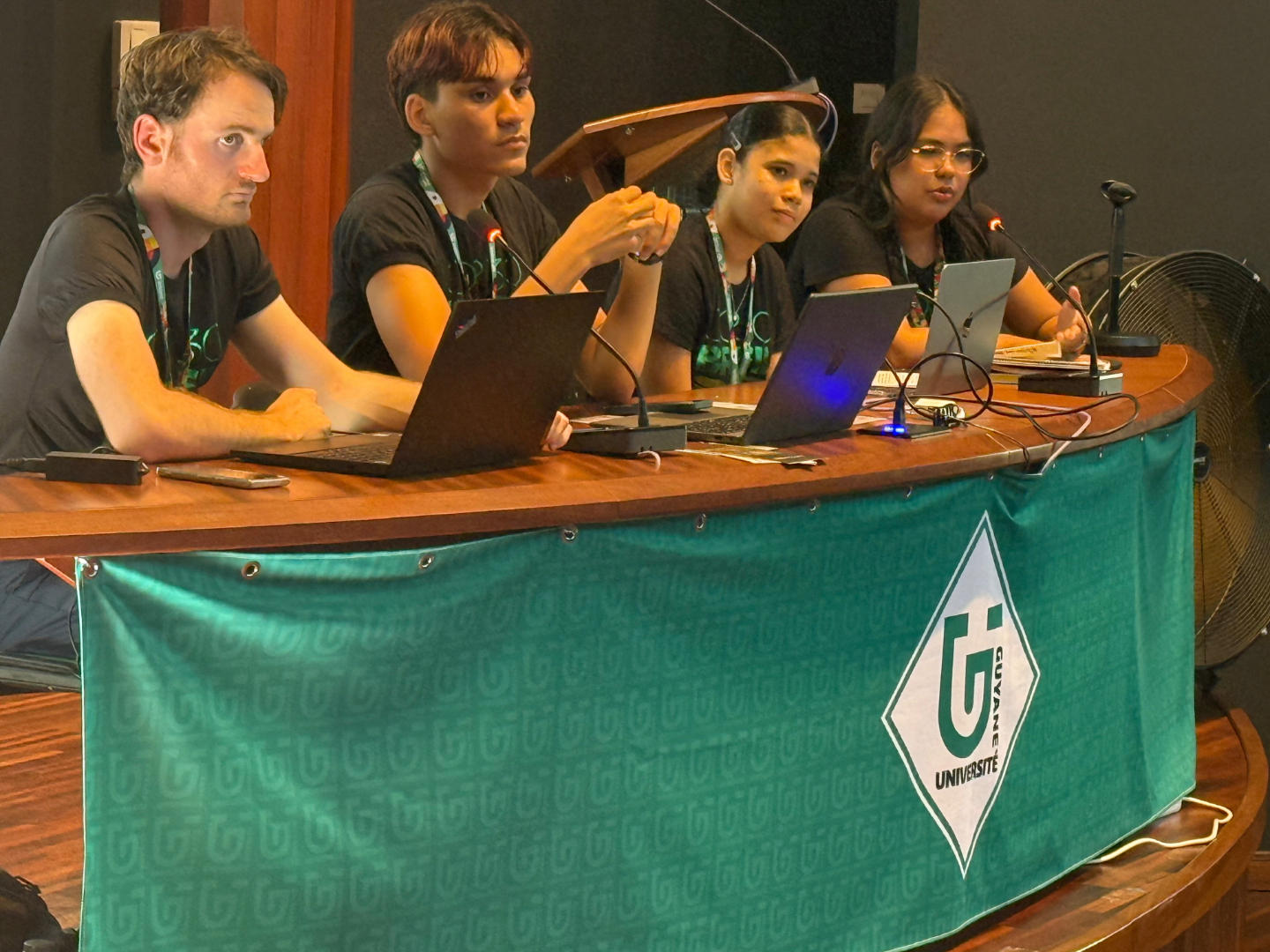
Upon their return from COP30, the Guyanese student ambassadors organised a debriefing ceremony to share the lessons learned, commitments made and perspectives gained during this major international event. It was a highlight of knowledge sharing, dialogue and mobilisation around climate, social and territorial issues specific to French Guiana.
COP30 was held in Belém, capital of the state of Pará, in the heart of the Brazilian Amazon.
The choice of this city was not insignificant: for the first time, a global climate conference was held in an Amazonian metropolis, a powerful symbol of the strategic, environmental and human importance of this region in international climate discussions. This location helped to highlight issues that are often marginalised, combining biodiversity protection, social justice and recognition of indigenous peoples.
French Guiana was represented by four students from the University of French Guiana — Sthefany Flores Martadinala, Edson Da Pai Xao e Silva, Joyce Justin and Basile Tschora — who served as ambassadors. Their participation enabled them to bring the voice of French Guiana's youth to an international forum for dialogue, while promoting exchanges with other student and institutional delegations from around the world.
During COP30, ambassadors discovered the different areas that structured the event. The Blue Zone, reserved for official negotiations between states, was the focus of diplomatic discussions, while the Green Zone offered an open space for civil society, innovation and citizen participation.
«This experience shows the importance of young people getting involved, and including young people in this debate gives us an idea of how to take action against climate change.» -Edson
The students also took part in memorable meetings with young Amazonian leaders, attended lectures at the Federal University of Pará and discovered Franco-Brazilian cooperation projects, notably the Iaraçu programme. These exchanges enriched their understanding of local and international dynamics related to climate change.
Beyond the political issues, this trip was a true cultural and human journey. Discovering the local cuisine — wassaï, tacacá, maniçoba — the historical heritage and art exhibitions of Belém reinforced the ambassadors' conviction that the fight against climate change cannot be separated from social, cultural and territorial realities.
During the debriefing ceremony, students shared their perspectives for French Guiana, expressing their desire to extend the momentum of COP30 at the local level. Among the ideas discussed were organising *mayouri* more frequently, appointing eco-delegates, stepping up awareness-raising initiatives, promoting waste sorting and reduction, and creating an association dedicated to climate action in French Guiana.
FAQ – COP30: student ambassadors deliver a powerful message for the future of the region
1- What is COP30?
COP30 is a global climate conference bringing together governments, experts and citizens to combat climate change.
2- Where was it held?
In Belém, in the Brazilian Amazon, a symbolic choice highlighting the environmental, social and human issues facing this region.
3- Who represented French Guiana?
Four students from the University of Guyana, engaged as ambassadors for Guyanese youth.
4- Why is their participation important?
They brought the voice of young people to an international forum for dialogue and exchanged views with delegations from around the world.
5- What are the differences between the Blue Zone and the Green Zone?
The Blue Zone is dedicated to official negotiations between states, while the Green Zone is open to civil society and citizen initiatives.
6- What follow-up measures are planned in French Guiana?
Local actions are proposed, such as raising awareness, appointing eco-delegates and reducing waste.


 EN
EN  FR
FR  PT
PT  NL
NL  ES
ES