

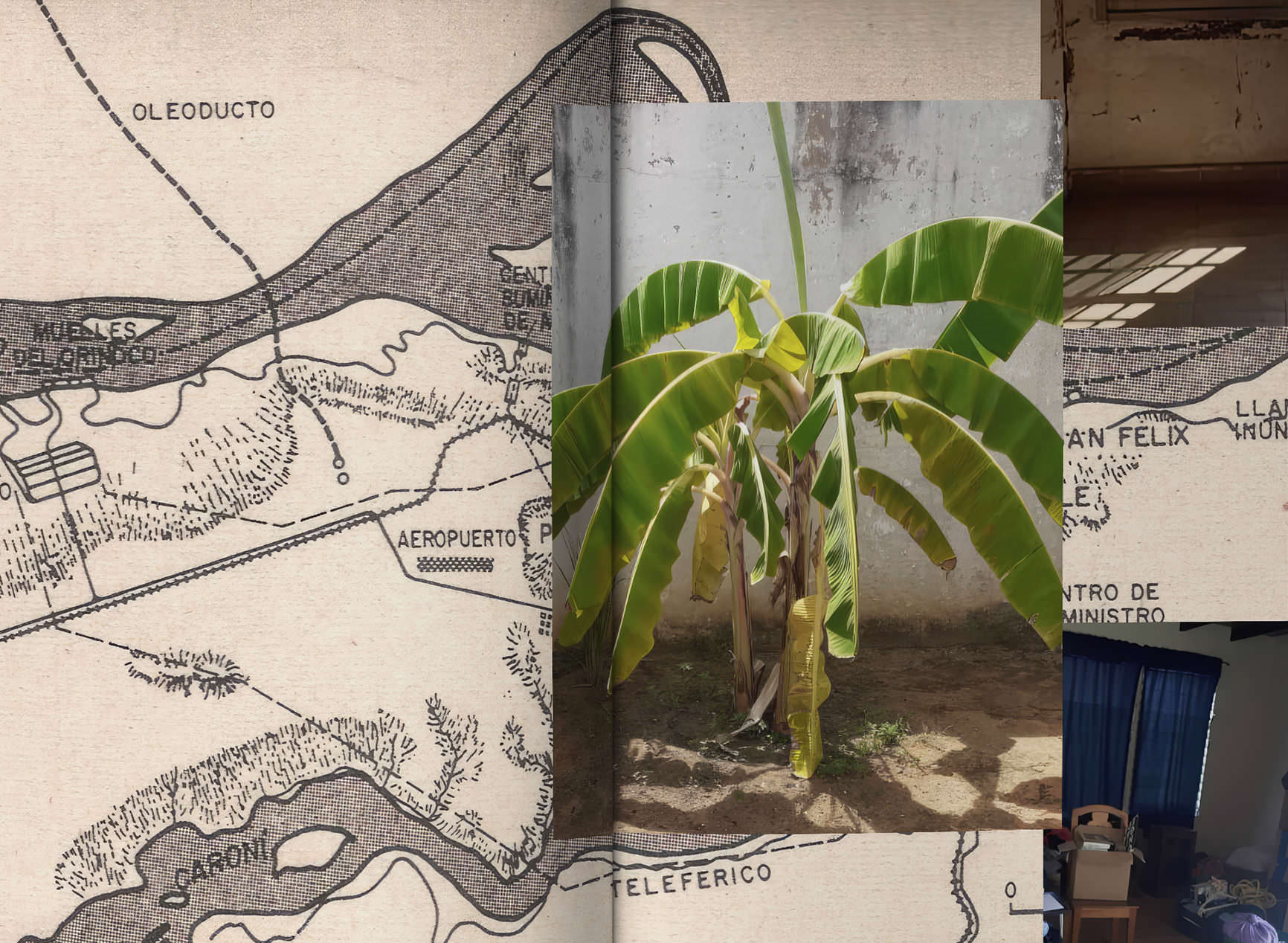
Patria by Oleñka Carrasco was studied on 19 January 2026 at the University of Guyana as part of the Seminar: Borders, Ethnicity and the Politics of Recognition in Amazonia, through a visual and textual analysis of migratory mourning and the processes of identity reconstruction linked to exile.
Part of the Seminar: Borders, Ethnicity and the Politics of Recognition in Amazonia
This analysis of Patria is an integral part of the Seminar: Borders, Ethnicity and the Politics of Recognition in Amazonia, organised by the University of Guyana. This scientific series explores contemporary dynamics linked to borders, human movements and cultural recognition processes. The session takes place on Monday 19 January 2026, from 4pm to 6pm, in amphitheatre E on the Troubiran campus. It is aimed at students, researchers and teachers interested in cultural studies, migration and the relationship between the arts and the humanities.
Patria, a photo album rooted in the experience of exile
Published in 2023, Patria is a phototext album by Venezuelan artist Oleñka Carrasco. Exiled from her native country since 2003, she has lived successively in Spain and France, where she has developed an artistic practice deeply marked by migration and memory. The work articulates a double experience of mourning. It relates the loss of the father to the definitive estrangement from the homeland, understood both as a geographical territory and as a symbolic space of belonging.
The materiality of mourning through maps
In Patria, The geographical map becomes a central material. Torn, superimposed or annotated, it visually translates rupture, fragmentation and the impossibility of return. These plastic gestures give concrete form to an intimate experience of loss. The map ceases to be a neutral locational tool. It becomes a medium of memory and a narrative space where individual and collective history intersect.
A critical reading by Elisa Bricco
The session will be led by :contentReference[oaicite:1]{index=1}, a professor of French literature at the Université de Paris. Her talk combines a technical approach, focusing on the composition of the images, with a narrative analysis centred on the autobiographical narrative. This reading highlights the hybrid dimension of Patria, At the crossroads of the intimate and the political, it highlights the way in which the work questions cultural boundaries and identities.
Interculturality and recognition as part of the seminar
Through the analysis of Patria, The Seminar: Borders, Ethnicity and the Politics of Recognition in the Amazon approaches interculturality as a dynamic process. Carrasco's work reveals forms of adaptation, but also of resistance, specific to the migratory experience. This session illustrates the seminar's commitment to combining theoretical reflection with artistic case studies, in order to gain a better understanding of the contemporary issues of recognition and memory.
Analysis of Patria by Oleñka Carrasco, part of the Seminar on Borders, Ethnicity and the Politics of Recognition in Amazonia, sheds light on the links between exile, memory and identity. By bringing together art and the human sciences, this session offers essential keys to thinking about migratory mourning. Attending this event will give you a deeper understanding of contemporary intercultural dynamics.
Elisa Bricco is Professor of French Literature at the Università di Genova. Director of the PhD in Digital Humanities - Technologies, Cultures, Arts and Communication, she coordinates ciVIS (Centro di Ricerca interdipartimentale sulla Visualità). She has published several studies on the contemporary French novel and on the intermedial relationship between art and literature. In 2023 she co-edited with C. Rolla a dossier on Art and the Anthropocene for the online journal Arabeschi (n. 18). Her latest book is Poétique du miniphototexte (Brill, 2025). She directs the online journal Publifarum and the ARGEC research group (Atelier de recherches génois sur les écritures contemporaines, http://argec.hypotheses.org). She has published several articles on migration and memory in a postcolonial context:
- «Raccontare la memoria coloniale: sguardi multipli su un archivio fotografico», Novecento Transnazionale. Letterature, arti e culture, 7, 2023, Esperienze complesse della memoria: immagini, testi, luoghi, oggetti. DOI: https://doi.org/10.13133/2532-1994/18315
- «A question of the gaze? La marque coloniale chez les écrivaines afropéennes», Oltreoceano, 22, 2022, Mémoire coloniale et fractures dans les représentations culturelles d'auteures contemporaines, Catherine Douzou & Valeria Sperti, 77-94, DOI 10.5354/Oltreceano51
- «Ne tenir qu'à un fil. Le récit de soi dans le dispositif phototextuel de Sylvie Laliberté», Oltreoceano (in press)
- «Le récit de l'enfance entre jeu et honte des origines dans les phototextes de Sylvie Laliberté», Francofonia, (in press.)
- «Un oceano pieno di virgole: il lutto di Oleñka Carrasco. Fototesto artistico ed espressione del trauma», in E. Bricco, M. Gaboriaud, Fototesto (auto)biografico: confini e traumi, Genova, GUP, (in press).
FAQ
When is the screening of Oleñka Carrasco's Patria?
The session takes place on Monday 19 January 2026, from 4pm to 6pm, at the University of Guyana.
What is the background to this analysis of Patria?
It is part of the Seminar: Borders, Ethnicity and the Politics of Recognition in Amazonia.
Who is the speaker for this session?
The session is led by Elisa Bricco, Professor of French Literature at the Università di Genova.
What is the main theme of Patria?
The work explores migratory mourning and the reconstruction of identity based on the experience of exile.
Who is this seminar session for?
It is aimed at students, researchers and anyone interested in issues of migration, art and interculturality.

 EN
EN  FR
FR  PT
PT  NL
NL  ES
ES