

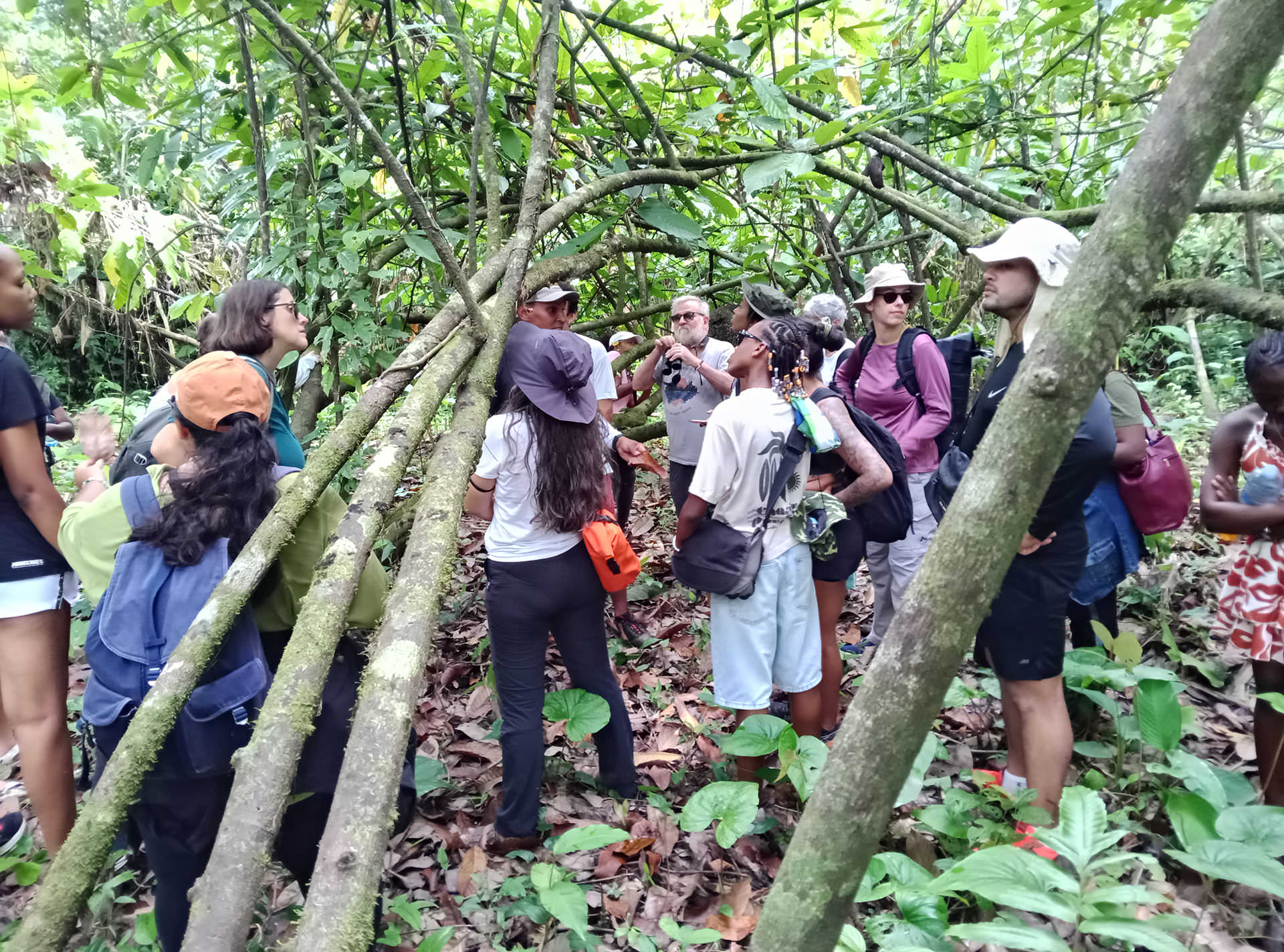
The GSA seminar on the Workshop on the Guiana-Brazil border, held on 29 May at the University of French Guiana, looks back at a scientific workshop held between eastern Guiana and Oiapoque in Brazil on the issues of biodiversity, sustainable food and university cooperation in Amazonia.
A seminar organised at the University of Guyana
The «Borders, Circulations, Interculturalities and Human-Milieu Interactions» seminar will take place on Friday 29 May from 4pm to 7pm in Amphi M of the University of Guyana's research building, on the Troubiran campus.
This special session is organised with the Graduate School of Amazonia by Agnès Clerc-Renaud, Damien Davy, Rosuel Lima-Pereira and Marianne Palisse as part of the MINEA-LEEISA interlaboratory seminar.
This scientific meeting will take the form of a feedback seminar on the workshop organised on the Guyana-Brazil border. A number of speakers will be taking part, including Manoela Araújo da Silva Elizângela, Marie Guénolé, Cécile Lony, Diane-Mica Malivert and Michel Rapinski.
A workshop organised between Eastern Guyana and Oiapoque
The border workshop took place from 24 to 28 November 2025 between eastern Guyana and the town of Oiapoque in Brazil. It was organised by the Civilisations, Cultures and Societies - Societies and Interculturality (CCS-SI) Master's programme, «Amazonian Societies and Biodiversity».
This scientific and educational project brought together students, teacher-researchers and a number of institutional partners to address the issues of biocultural diversity and sustainable food in Amazonia.
Designed as an immersion in the field, the workshop gave students their first experience of international scientific communication. It also strengthened the links between the various Masters courses at the University of Guyana under the aegis of the Graduate School of Amazonia.
The exchanges also involved students and teachers from the Federal University of Amapá (UNIFAP). Participants took part in field visits, master classes, scientific seminars and interdisciplinary exchanges.
These exchanges focused in particular on sustainable food and cross-border territorial dynamics. They provided an opportunity to link field experience with the scientific issues common to French Guiana and Brazil.
Scientific exchanges on Amazonian issues
One of the highlights of the week was participation in the Observatoire Hommes-Milieux Oyapock seminar and the 4th DYAGA seminar. These meetings encouraged dialogue between young researchers and experts from both countries.
The discussions contributed to a better understanding of the issues common to this border region. Questions of biocultural diversity, interculturality, sustainable food and territorial dynamics were central to the discussions.
The feedback seminar on 29 May will provide an opportunity to review the work carried out during the workshop. It will also be an opportunity to share experiences and to promote the results of this immersion.
This initiative is part of a dynamic of sustainable scientific cooperation between French Guiana and Brazil. It demonstrates the CCS-SI Master's commitment to the internationalisation of courses and training through research.
The Graduate School of Amazonia supports this approach as part of its mission. In particular, it encourages students to make the transition to doctoral studies.
A wide range of scientific papers
A selection of the papers from the workshop on the border will be presented at the Guyana-Brazil border seminar. The presentations will be followed by a discussion between the speakers.
Diane Mica Malivert will be presenting a paper entitled «Dietary practices of pregnant and post-partum women of Haitian origin in French Guyana: between cultural heritage and local adaptations».
Manoela Araújo da Silva Elizângela will be speaking on «The Border Intercultural Bilingual Schools Programme (PEIBF) in the twin towns of Oiapoque (Brazil) and Saint-Georges (French Guiana): opportunities, obstacles and prospects for implementation».
Marie Guénolé will give a talk entitled «Maisons et mobilités féminines, réflexion sur le genre et la parenté à partir de la société Ndjuka de Guyane».
Cécile Lony will be presenting «Food in Guyana's carnival: cultural uses and therapeutic practices».
Michel Rapinski will be talking about «Cassava, a key species in the diet of the Parikwene people, threats and prospects».
Alizée de Bollardiere «Communities ribeirinhos, Small-scale fishing and adaptation strategies: impacts on local food supplies in the Oiapoque estuary».»
The session will be presented by Rosuel Lima-Pereira, vice-president of international relations at the University of Guyana, and Damien Davy, director of the Observatoire Hommes-Milieux Oyapock.
The Guyana-Brazil border seminar highlights the scientific and academic exchanges between French Guiana and Brazil on Amazonian issues. The seminar will showcase the work carried out in the field and highlight the importance of international cooperation in research. Students, researchers and institutional partners will be able to share their experiences and continue the dialogue on cross-border dynamics and sustainable food in Amazonia.
FAQ
When does it take place? the feedback seminar of the GSA from the workshop to the border ?
The seminar will be held on Friday 29 May from 4pm to 7pm at the University of Guyana. It will take place in Amphi M of the research building on the Troubiran campus.
What is the aim of this seminar?
The seminar will provide an opportunity to review the work carried out during the workshop organised between French Guiana and Brazil. It also promotes scientific exchanges on Amazonian issues.
Who is organising this scientific event?
The event is organised by Agnès Clerc-Renaud, Damien Davy, Rosuel Lima-Pereira and Marianne Palisse. It is coordinated with the GSA (Graduate School of Amazonia).
What topics will be covered during the seminar?
The presentations will focus on sustainable food, cultural practices, women's mobility, border bilingualism and territorial dynamics in Amazonia.
Which schools are taking part in the workshop?
The workshop involves the University of Guyana and the Federal University of Amapá (UNIFAP). Students, researchers and institutional partners from both countries are taking part in the exchanges.
Why is this workshop important for students?
This immersion in the field offers a first experience of international scientific communication. It also encourages training through research and opens the door to a doctoral programme.


 EN
EN  FR
FR  PT
PT  NL
NL  ES
ES