

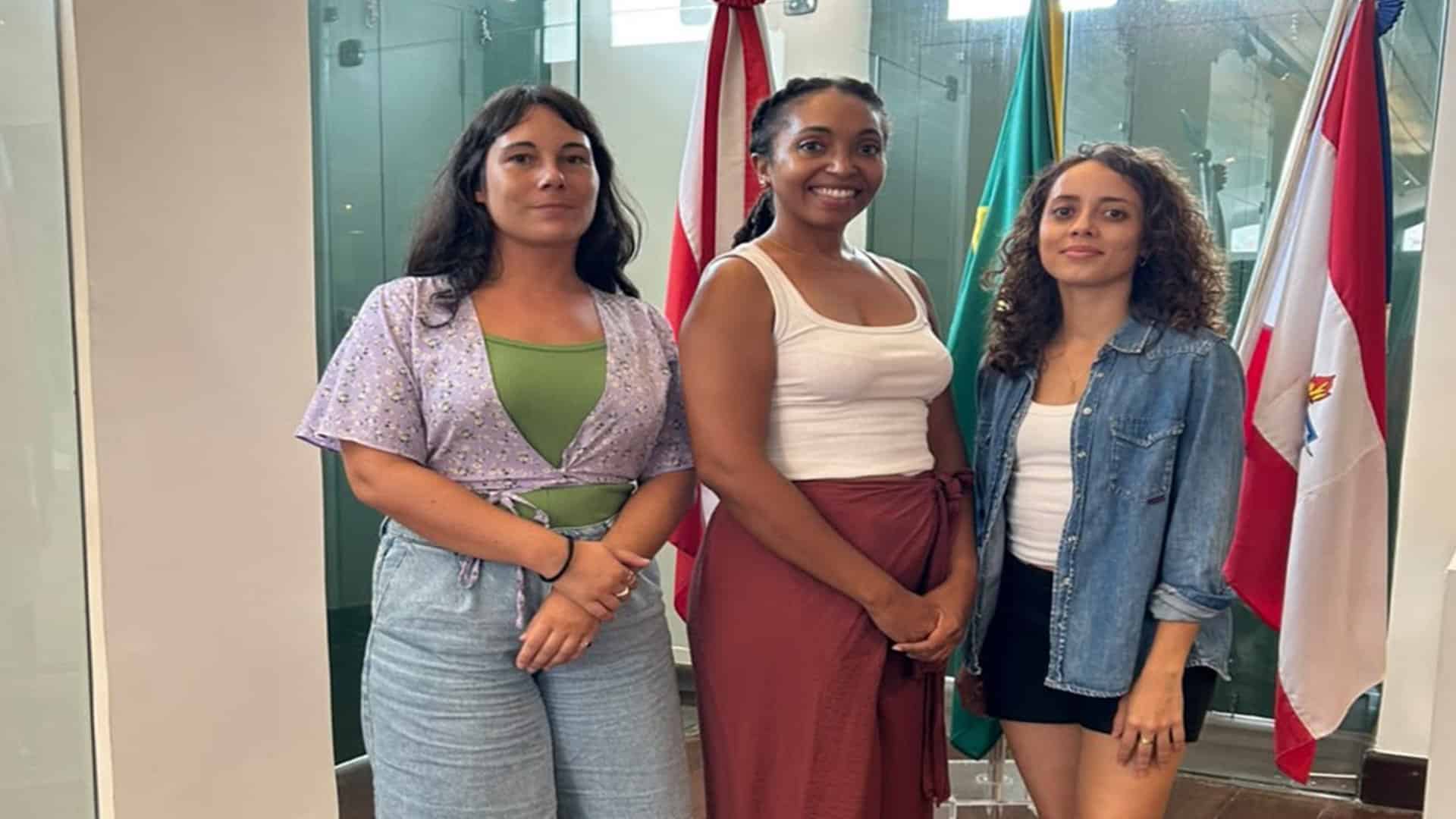
From 18 to 29 September 2026, three students from the University of French Guiana took part in an immersive course on socio-bioeconomics in Belém and Santarém, Brazil. Through field visits, lectures and group work, they explored the challenges facing the Amazon.
Academic cooperation between French Guiana, France and Brazil
The immersive programme on socio-bioeconomics was established through a collaboration between several French and Brazilian universities. It aims to strengthen scientific and educational exchanges on issues relating to the Amazon.
This first edition is the result of a partnership between the Federal University of Pará (UFPA), represented by Professor José Augusto Lacerda, and the University of Paris-Est Créteil (UPEC), represented by Senior Lecturer Felipe Koch.
The Federal University of Western Pará has also joined this initiative. For their part, the University of Guyana and the French Embassy in Brazil have provided institutional support for the project.
Nadège Mézié, an international technical expert with Expertise France, also helped organise this immersive course.
Furthermore, the project Amabio, led by Expertise France, and the European University Alliance Aurora funded this first summer school.
The French initiative Amabio aims, in particular, to boost funding for the bioeconomy in the Amazon. To this end, it works with public development banks to promote a sustainable and inclusive approach.
This academic collaboration thus brings together researchers, students and local stakeholders. It promotes a better understanding of the regions, Amazonian resources and practices relating to the socio-bioeconomy.
Three students from the University of French Guiana have been selected
In July 2026, the Office of International Relations at the University of French Guiana launched a call for applications in partnership with the French Embassy in Brazil. This call was aimed at Master’s and PhD students.
Following the selection process, three candidates were shortlisted: Emmanuelle Renard, Alizée de Bollardière and Vitória Taïlamé.
Emmanuelle Renard is a Master’s student on the Civilisations, Cultures, Societies and Interculturalities (CCS-SI) programme. Her research focuses on promotional items and their circulation in southern French Guiana.
She is also interested in more sustainable alternatives. Her work takes into account the region’s resources, local communities and the opportunities offered by the socio-bioeconomy.
Alizée de Bollardière is preparing a PhD in social anthropology at LEEISA, the Laboratory for Ecology, Evolution and Interaction of Amazonian Systems. She is studying small-scale coastal fishing and the movement of people between French Guiana and Brazil.
Vitória Taïlamé is a PhD student in civil engineering at the ECOFOG laboratory (Ecology of the Forests of French Guiana). She is undertaking a CIFRE PhD at the company La Brique de Guyane.
His research focuses on earthen building materials that incorporate local biological resources.
These three research programmes demonstrate the diversity of research being carried out in French Guiana. They combine the social, cultural, environmental and technical aspects of the bioeconomy with the practical challenges facing the Amazon region.
Amabio covered the full cost of the three students’ stay from the University of French Guiana.
Two weeks of immersion between Belém and Santarém
The International Immersive School on Socio-Bioeconomics took place from 18 to 29 September 2026 in the state of Pará, Brazil. The programme was organised in two stages, first in Belém and then in Santarém.
During this period, participants took part in a mix of academic activities, lectures, group work, field trips and meetings with local stakeholders.
In particular, they held discussions with women’s organisations, craftspeople, cooperatives, farmers and community leaders.
Several themes guided the discussions, including local and traditional knowledge, family farming and agricultural practices in the Amazonian context.
This approach enabled the students to compare their academic knowledge with the realities on the ground. It also highlighted the knowledge developed by the communities living in the Amazonian regions.
Discovering Amazonian communities and protected areas
Participants in this immersive course on socio-bioeconomics visited several Amazonian communities. In particular, they travelled to a indigenous village, an Indigenous village, as well as in several communities ribeirinhas, situated along the banks of watercourses.
These visits took place in three categories of conservation areas in Brazil. They illustrate the diversity of the administrative and legal frameworks governing the protection of natural areas.
The students thus learnt about a RESEX (Extractive Reserve), an APA (Environmental Protection Area) and a FLONA (National Forest).
These various schemes provide an insight into different approaches to land management. They also offer perspectives on how communities develop their socio-bioeconomic activities.
Through these meetings, participants were able to gain a better understanding of the links between the conservation of natural habitats, local economic activities and community knowledge.
Research and knowledge shared across the Amazon region
From French Guiana to Pará, this immersive school has fostered dialogue between academic research and the knowledge of Amazonian communities.
It also provided an opportunity to explore ways of promoting the socio-bioeconomy based on local realities. The discussions thus brought together different scientific approaches and practical experiences.
For students, this experience offers an opportunity to discover alternative research methods and to compare their work with the practices of local stakeholders.
Finally, this regional cooperation strengthens ties between institutions and partners on both sides of the border between French Guiana and Brazil.
It helps to share knowledge, methods and experiences relating to challenges common to Amazonian regions.
Amazonian cooperation to promote academic exchanges
This first immersive course on socio-bioeconomics highlights the value of academic collaboration between French Guiana and Brazil. Over the course of two weeks, the three students from the University of French Guiana explored local initiatives and engaged with researchers, students and communities in the Amazon.
This experience highlights the importance of dialogue between scientific knowledge and local knowledge in order to better understand the challenges of the socio-bioeconomy.
To find out more about the initiatives that support this cooperation, please see the project resources Amabio and the university alliance Aurora.
FAQ
What is the immersive course on socio-bioeconomics?
This is an international programme combining academic activities, conferences and field visits. It enables participants to explore socio-bioeconomic issues through the lens of the realities of the Amazonian regions.
When and where did this immersive course take place?
The course took place from 18 to 29 September 2026 in the state of Pará, Brazil. The activities were held in Belém and Santarém.
Which female students represented the University of French Guiana?
Three students took part: Emmanuelle Renard, a Master’s student in CCS-SI; Alizée de Bollardière, a PhD student in social anthropology at LEEISA; and Vitória Taïlamé, a PhD student in civil engineering at the ECOFOG laboratory.
Which organisations organised this immersive school programme?
The initiative arose from a collaboration between the Federal University of Pará and the University of Paris-Est Créteil. The Federal University of Western Pará has joined the project. The University of French Guiana and the French Embassy have provided institutional support.
Which partners funded this summer school?
The Amabio project, led by Expertise France, and the European university alliance Aurora provided financial support. Amabio also covered the costs of the stay for the three students from the University of French Guiana.
What topics did the participants study in Brazil?
The discussions focused on traditional knowledge, family farming and the management of Amazonian territories. The participants also visited several local communities and learnt about three categories of conservation areas: RESEX, APA and FLONA.
in the Amazon. The poster for the event announces that the meeting will take place on 1 October at 2.00 pm in the IFCH Auditorium at UFPA.


 EN
EN  FR
FR  PT
PT  NL
NL  ES
ES